Why a horse has to lie down to sleep properly
A horse can doze on his feet, but REM sleep, the restorative kind, only comes lying down with his head on the ground. That’s why the most telling sign in the research is a horse nobody has seen lie down. What four studies say about it, and why the figure everyone quotes has no source.

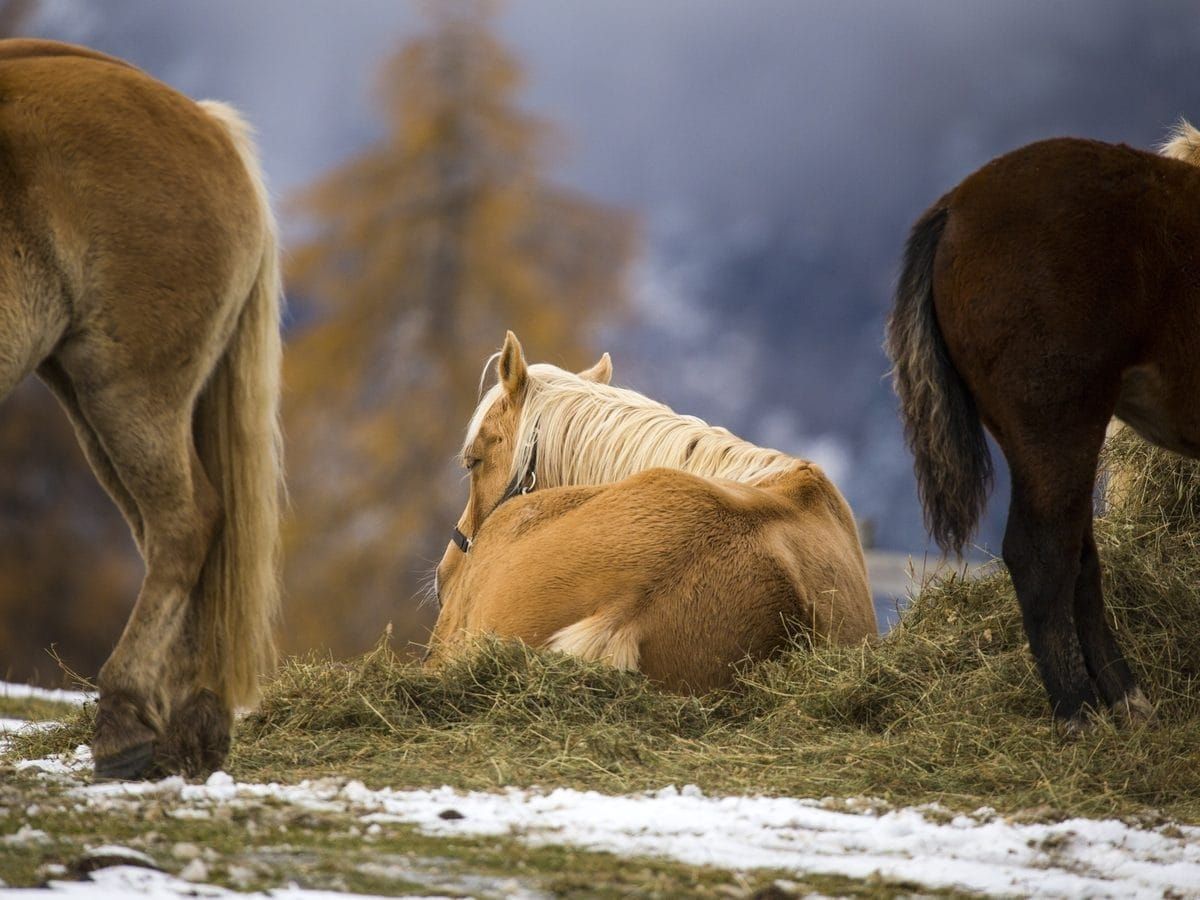
Most stabled-horse owners will recognise the habit of reading the bed each morning. A shape pressed into banked shavings, flakes caught in the mane, and the conclusion that things are fine. But what can that shape really tell us? Not how long he was down, the quality of sleep, or what it would mean if it stopped appearing.
So here's what the research actually shows, and where it runs out. It runs out sooner than the internet suggests.
The short version
Four things the research actually says
Every figure below is unpacked, with its caveats, further down.
-
01
3h 40m
Total sleep in 24 hours
And it arrives in pieces. Around 40 minutes of that is REM, in roughly ten bouts averaging under four minutes each.
-
02
Muzzle down
The test for REM
Not standing versus lying. A horse on his chest with his head still held scores the same as a horse asleep on his feet.
-
03
Nobody knows
How long he can go without
The seven-to-14-nights figure everyone quotes traces back to a supplement company and a 2003 study of people.
-
04
24 vs 59 min
REM, quitters against persisters
In a field learning test, short REM predicted which horses walked away. It did not predict mistakes.
If you take one thing from this: the cheapest instrument in the whole field is a camera pointed at the stable overnight.
What a horse's night actually looks like
Almost everything we know about a horse's night comes from one 2022 review, by Linda Greening at Hartpury and Sebastian McBride at Aberystwyth, which gathered the scattered studies into one place.
Total sleep comes to somewhere around three and a half to four hours in 24, though the figure depends on how it's measured. Studies that wired horses up put it between just under three and about four and a half hours. Studies that judged sleep by watching range from about one hour to more than six, which says more about how hard sleep is to judge by eye than about horses.
What matters more than the total is the shape. We sleep in four or five long cycles, with dreaming spells of around 22 minutes. A horse gets about ten REM spells a night, averaging under four minutes each, and between them he wakes constantly: around seven times in every sleep cycle, mostly for less than a minute.
So a horse's night is not a shorter version of ours. It is a different substance.
Figure 1
One night, four stages
A stabled horse, 8pm to 8am. Hover or tap a band to see what the horse's body is doing. The ember bands are REM. In this illustrative night there are 11 of them, each under five minutes; across studies, REM bouts average under four minutes.
Swipe the night sideways to reach the morning.
| From | To | Stage | Mins |
|---|
Why REM needs him on the ground
In REM sleep the body's muscles go almost completely slack. It's why we don't act out our dreams, and why a horse can't stay on his feet through it.
Drowsing and slow-wave sleep come easily on his feet. About three-quarters of a standing horse's sleep is slow-wave, which is real, restorative sleep, so a dozing horse is not getting nothing. What he is not getting is REM, and REM needs him down, either flat on his side or on his chest with the muzzle actually resting on the floor. Researchers count a horse lying on his chest with his head held up as being in slow-wave sleep, and one with his muzzle resting on the floor as being in REM. That is the whole distinction, and it is finer than most of us have been taught.
There is one exception, and it is worth knowing because it explains a frightening thing owners sometimes see. A horse very short of REM can slide into it standing up. Neck tone goes, the head drops, the forelegs buckle, and the muzzle hits the floor, at which point the horse wakes up. Brief, rare, and self-terminating. It is also the single most visible sign that something has gone wrong.
Figure 2
What each posture allows
The line is not standing versus lying. It is whether the neck is genuinely unsupported. Keep scrolling.
- Drowsiness
- NREM, slow-wave
- REM
Standing
Stay apparatus engaged, three legs loaded, one hind rested. Around three-quarters of a standing horse's sleep is slow-wave, so a dozing horse is not getting nothing. What he cannot get here is REM, because tone drops to almost nothing in REM and he would go over.
Sternal
Lying on the chest — and this is where the distinction gets finer than most of us were taught. Down is not the test. The muzzle is. A horse can be lying on his chest with his head still held and be scored as slow-wave sleep, no differently from standing.
Lateral
Flat on the side, legs extended, neck along the ground. Full atonia. This is the posture that worries people who find their horse like it, and on the review's own figures it is the one doing the most work.
Is it normal for a horse never to lie down?
The best evidence on that question is a survey, with everything that implies. Heli Suomala and colleagues at Helsinki asked 1,749 owners in Finland, Sweden and Norway one deceptively simple thing: do you think your horse has problems related to rest or sleep? Of those, 88 said yes. Then they looked at what the 88 had in common.
Two numbers dominate. Owners whose horse had lost its balance or gone down unexpectedly in the past year were 40 times more likely to suspect a sleep problem. Owners who had never seen their horse lie down were 28 times more likely.
That second sentence needs reading twice, because it is not what it first appears to be. It does not say that horses who never lie down are 28 times more likely to have a sleep problem. It says that owners who have never watched their horse lie down are 28 times more likely to think something is wrong. Both halves come from the same person filling in the same form on the same afternoon, so part of the link is built in from the start. The authors knew that, which is why they treated it as a sign of a problem rather than a cause.
And the true figure could plausibly be anywhere from nine to 89 times, which is a polite way of saying the estimate rests on 32 horses: 16 whose owners were worried, 16 whose owners were not.
None of which makes it useless. A lower bound of nine is still a large effect, and the finding has a plain mechanical reading that does not depend on the statistics at all. If nobody has ever seen the horse lie down, nobody knows whether he does.
Figure 3
What raises the odds, and by how much
"Three times more likely" means suspected sleep disturbance was three times as common among horses with that factor. It does not mean your horse has a one-in-three chance of anything.
What may cause itThe authors' first model: management and horse factors.
What you can see once it existsA separate model. These numbers are not interchangeable with the ones above.
Possible causes
Possible consequences
Log scale. The dot is the adjusted odds ratio, the bar is the 95% confidence interval, and the dashed line at 1 means no association. Swipe sideways on a phone. Notice how long some of those bars are.
How long can a horse go without lying down?
Nobody knows.
Not approximately, not within a range, and not in any published source I could find. Greening and McBride say it themselves, at the end of a review of the entire literature: it is "not known at what point sleep deprivation becomes chronic". Joe Bertone, who has seen more of these cases than almost anyone, puts it in his own proceedings as "several days" and leaves it there.
Which is odd, because a number circulates freely. Search for it and you will be told that a horse can manage three or four nights without lying down, and that trouble starts somewhere between seven and 14 nights. I have seen that figure repeated as though it were settled.
Here is where it comes from. The most prominent source for it is an article on the website of an American supplement company, which quotes a veterinary researcher saying that problems begin when a horse goes "seven to 14 nights without proper REM sleep". The same article states that 90% of sleep-deprived horses will be injured, attributed to "a study", with no citation given. Neither figure appears in that researcher's own published work.
The number 14 does appear in the equine sleep literature, a few lines away from equine material in the Greening and McBride review. It is human. It comes from a 2003 study of people put on 14 consecutive nights of restricted sleep, and it is a definition of chronic deprivation in humans rather than a threshold for horses. That is almost certainly the whole provenance.
One more claim in this family deserves the same treatment. The January 2026 Helsinki paper states that horses can suppress REM sleep entirely for up to several weeks, and cites a 1986 review in Veterinary Clinics of North America. A review, not a study. Whether the figure originates there is not something I could establish, because the full text is behind a paywall and no open copy exists.
So the honest position is this. Sleep deprivation from not lying down is real, it is documented, and it ends in collapse. How many nights it takes is not known, and everyone who tells you otherwise is quoting a supplement company or a study about people.
What stops a horse lying down
The Suomala data points at four things: pain, size, age, and the surface.
The surface is the one an owner can change tonight, and it is worth being careful about what the study actually found. Softness and dryness were not tested separately. They were combined into one measure, taken by kneeling on the bed where the horse lies and asking two questions: does it hurt, and are your knees wet after 15 seconds. Hard and dry came out at 3.5 times the odds. Hard and wet came out at 8.6.
The survey barely looked at depth. It only asked whether the bed was more or less than 5cm deep, found no link, and dropped it. Helsinki's own press release nonetheless says the amount of bedding matters more than the type, which is not what their paper reports.
But the wider literature does support depth, and this is where the survey and the experiments part company. Greening and McBride, reviewing the studies that actually manipulated bedding rather than asking owners about it, report that depths under 10cm significantly reduce how often a horse lies down at all, whatever the material. The experiments changed something. The survey only asked.
So the banked-up bed was not sentiment. It was closer to right than the survey suggests, and the reason to keep doing it is that under 10cm the horse stops going down.
Then there is everything that breaks a night up without shortening it. In 2023 Greening and colleagues made the first serious attempt to measure how well horses sleep, not just how long. Horses can't tell us how they slept, so the team borrowed a trick from human sleep science and counted how often sleep was interrupted. The principle is simple: a night in pieces is not the same night as one that ran through, even when the totals match.
Figure 4
Same total REM, different night
Both horses got 40 minutes. Look at the shape of it before you reveal the arithmetic.
Horse A, 11 bouts
REM quality index:3.3Horse B, 24 bouts
REM quality index:1.6Which means the observation most of us would be quietly pleased about, that he lay down four times last night, might be the wrong thing to be pleased about.
What people call lazy
In January 2026 Mira Hämäläinen, Iina Brotherus and colleagues at Helsinki published the first field test of whether the way a horse sleeps predicts how he behaves while learning something.
The kit list is the best thing about it: two researchers, two upturned rubber buckets, three car tyres to stop the buckets wandering, and a kilo of carrot slices per horse per phase. There were 16 riding-school horses, mean age 15, tested in their own paddocks rather than a laboratory. Their sleep was filmed two nights at a time, five times over six weeks, and scored from the footage by a single person who did not know how each horse had done in the learning test, or how deep its bedding was.
Figure 5
The spatial reversal learning test
Two buckets, one rule, and a rule that keeps changing. The apple marks the correct choice at each stage.
Horse learns: left means treat
Hits threshold, seven correct in a minute
Rule flips, now right means treat
Hits threshold again
Rule flips back, left again
Each time a horse learns the new rule and hits the threshold, that is one completed reversal. The test keeps flipping. The question is not whether the horse gets it right. It is how many rounds he will keep trying before he walks off.
What they found
REM duration did not predict errors. It predicted willingness to keep trying.
The horses who quit were not making more mistakes. Error rate showed no relationship with sleep at all. What sleep predicted was how long a horse would keep engaging with a task that kept moving the goalposts.
A test that counts only mistakes misses the thing that matters most in a horse's working life, which is whether he is still willing.
There is a second study worth putting next to it, because it comes at the same question from the opposite direction and nobody talks about it. In 2024, researchers in Brazil stopped ten young dressage horses from lying down for three days, then tested their memory. They were a little slower to solve the puzzle, though with ten horses and a result that fell short of statistical significance, hold it lightly. But it is one of very few experiments on restricting REM in competition horses, and it points the same way as Helsinki.
The collapse that usually isn't narcolepsy
There is a thread running through the veterinary literature that gets less attention than it should, about a diagnosis handed to adult horses who fall over.
True narcolepsy is a brain disorder, linked in people and dogs to a shortage of a brain chemical called hypocretin. There is a recognised hereditary form in miniature horses and in certain Lipizzaner lines, and it shows up in foals. UC Davis puts it plainly: narcolepsy is uncommon in horses, and episodes that look like it are more likely to come from sleep deprivation, whether because pain stops the horse lying down or because light and noise stop him sleeping.
The best evidence for that is a doctoral thesis, which is why almost nobody cites it. In 2017 Christine Fuchs at Ludwig-Maximilian University in Munich advertised in a horse magazine for owners of horses diagnosed with narcolepsy. She got 177 replies and examined 39 horses on their own yards: filmed around the clock, with their brain activity recorded, a clinical examination and blood tests. The collapse episodes averaged around 60 a day. In the worst cases they reached 199. Horses who lay down and rolled had significantly fewer of them, and her conclusion was that most of these horses were not neurologically ill. They were short of lying-down sleep, and the cause was in the housing.
Joe Bertone, emeritus professor at Western University of Health Sciences, has spent 20 years collecting these cases. He presented on 876 of them at the National Alliance of Equine Practitioners conference in Saratoga Springs in September 2024, and has said he has seen closer to 1,100 since. His position, as reported, is that no adult horse he has examined has met the criteria for true narcolepsy.
That figure deserves a caveat, and it is not a small one. The 876 cases have never been published. They exist in trade coverage of a talk, with no case definition, no methods and no denominator available to check. Bertone's peer-reviewed record on this runs to a textbook chapter and a 2006 case report describing two horses. The jump from two published cases to 1,100 spoken from a podium is the kind of gap that would normally make me leave a claim out. I have kept it because it is the only clinical caseload anyone has, and because a clinician saying "I have never once seen the real thing" is information even when it is unpublished. Read it as a clinician's impression, which is what it is.
The distinction changes what happens next. True narcolepsy might respond to drugs. REM deficiency needs somebody to work out why the horse is not lying down, and the answer is usually pain that makes standing up expensive, a surface he does not want to be on, or a stable where he has never felt safe enough to try.
What we say, and what it might be
Figure 6
Five readings worth swapping
Greening and McBride open their review by pointing out that sleep is not commonly treated as a welfare factor at all, despite being something every mammal needs. They name no framework in particular, and they do not need to. Look at any welfare checklist you have used and count the lines about rest.
When to worry, and when to call the vet
What follows is a prompt, not a test. It cannot tell you anything about your horse that you do not already know; what it can do is arrange what you know into the shape a vet will find useful. Every item in it was independently associated with suspected sleep disturbance in a survey of 1,749 owners, which is a much weaker thing than a diagnostic criterion.
Two of the five questions are about what you have observed rather than what is happening. That is deliberate, and it is the honest limit of the whole field. If the answer to "how often does he lie down" is "I don't know", that is the most useful answer you can give, because it is the one with a cheap fix.
Figure 7 · self-assessment
Five questions from the research
Not a diagnostic tool. It surfaces whether a conversation with your vet is worth having.
What's still open
Almost everything. Nobody knows the REM duration below which welfare is actually compromised. Nobody knows how much of the variation between horses is temperament and how much is the stable, and the authors of the Helsinki study say so. There is no figure for how long recovery takes once management improves, no non-invasive tool an ordinary owner can use at home, and no evidence yet on whether the sleep and willingness relationship holds outside a riding school, in older horses, or in the horses with clinical sleep symptoms that the study specifically excluded.
There is enough, though, to stop filing the sleep-short horse under training problem.
The move to a herd, and what it does not prove
Consider the horse this article keeps circling: the one nobody has seen lie down. Suppose his owner moves him to track livery, out with a herd, and within weeks sees him flat out in the middle of the afternoon, in company, another horse standing over him looking about. It invites the most comfortable thought in horsekeeping: they take turns.
It would be nice to report that the research supports that thought. It does not.
Start with the turn-taking, because it is the loveliest part and the weakest. In the equine literature that claim rests on a single article from 1990, in a small American practice journal, with no data behind it and no retrievable text. Greening and McBride repeat it and hedge it as a supposed rota. Meanwhile the largest study ever done on how horses coordinate rest, 126 feral horses filmed by drone across 20 days and 23,716 position records, found the opposite of a rota. Within a family group horses matched each other's state 93% of the time. They go down together and they get up together. The paper does not mention sentinels once.
There is a human version of this that I cannot stop thinking about. Researchers put activity monitors on a Hadza camp in Tanzania for 20 nights. Across the whole period, the total time when everyone was asleep at once came to 18 minutes. Near-perfect cover, all night, every night, and nobody was on a rota. It was just that the old people went to bed early and the young ones stayed up.
Then the move itself. There is no published study showing that taking a horse out of a stable and putting him in a herd improves his sleep. The best-designed test of almost exactly that comparison, published last year, found horses did lie down more with company and space, but not by enough to rule out chance. Another study put the same eight horses through single boxes and group shelters: they lay down for 145 minutes a night in a box, and 69 minutes in a group shelter at the legal minimum space. In the shelters, every horse was pushed back to its feet by another horse at least once. That cannot happen in a stable. The only track-system study with recumbency data has the track slightly lower than the comparison.
What group living does have behind it is a stress measure rather than a sleep one. Horses kept on their own have higher levels of stress hormones in their dung than horses kept in a group. The move can still be the right call, and the stress evidence alone may justify it. What it is not is a sleep intervention with published support, and the sleep claim is the one everyone reaches for.
And here is the part that is hardest to sit with. Every study of housing in this article measured posture. None of them recorded brain activity. The owner who turns a horse out and now sees him lie down has not acquired evidence that he sleeps better. She has acquired a view. Whether his sleep has changed is exactly as unknown as it was inside the stable.
Which is the same mistake as the shape in the shavings, made outdoors, in better light.
Sources
Hämäläinen MJ, Brotherus IL, Wigren H-KM, Kaimio TE, Suomala H, Olbricht A-M, Hänninen LT, Mykkänen AK. Effect of horse sleep behavior on performance in a field-side spatial reversal learning test. Scientific Reports 16, 4265 (2026). 10.1038/s41598-025-34463-9
Greening L, McBride S. A review of equine sleep: implications for equine welfare. Frontiers in Veterinary Science 9, 916737 (2022). 10.3389/fvets.2022.916737
Greening L, Allen S, McBride S. Towards an objective measurement of sleep quality in non-human animals. Biology Open 12, bio059964 (2023). 10.1242/bio.059964
Suomala H, Brotherus I, Hänninen L, Ternman E, Mykkänen AK. Risk factors associated with owner-reported sleep disturbances in Nordic horses. Equine Veterinary Journal 58(3), 728-735 (2026). 10.1111/evj.14560
Fuchs C. Narkolepsie oder REM-Schlafmangel? 24-Stunden-Überwachung und polysomnographische Messungen bei adulten "narkoleptischen" Pferden. Dr. med. vet. dissertation, Ludwig-Maximilians-Universität München (2017). edoc.ub.uni-muenchen.de/20588. Summarised in Fuchs C, Kiefner C, Reese S, Erhard M, Wöhr A-C, Equine Veterinary Journal 48(S50), 9 (2016), conference abstract.
Barbosa ÂP, Oliveira TM, Trindade PHE, Seidel SRT, Tokawa PKA, Jaramilo FM, Roncati NV, Baccarin RYA. Sleep pattern interference in the cognitive performance of Lusitano horses. Animals 14(2), 334 (2024). 10.3390/ani14020334
Maeda T, Sueur C, Hirata S, Yamamoto S. Behavioural synchronization in a multilevel society of feral horses. PLOS ONE 16(10), e0258944 (2021). 10.1371/journal.pone.0258944
Kjellberg L, Sassner H, Yngvesson J. Horses' resting behaviour in shelters of varying size compared with single boxes. Applied Animal Behaviour Science 254, 105715 (2022). 10.1016/j.applanim.2022.105715 And Helmerich P, Bachmann I, Gygax L. Comparing lying behaviour of young riding horses on days in an individual indoor box, on an outdoor paddock alone, or in pairs and in the following night. Equine Veterinary Journal 57(1), 277-281 (2025). 10.1111/evj.14041
Yarnell K, Hall C, Royle C, Walker SL. Domesticated horses differ in their behavioural and physiological responses to isolated and group housing. Physiology & Behavior 143, 51-57 (2015). 10.1016/j.physbeh.2015.02.040
Samson DR, Crittenden AN, Mabulla IA, Mabulla AZP, Nunn CL. Chronotype variation drives night-time sentinel-like behaviour in hunter-gatherers. Proceedings of the Royal Society B 284, 20170967 (2017). 10.1098/rspb.2017.0967
Bertone JJ. Sleep deprivation behaviour syndrome, 876 clinical cases. NAEP Saratoga Equine Practitioners Conference, Saratoga Springs, September 2024, reported in EquiManagement, January 2025. Peer-reviewed record: Bertone JJ. Excessive drowsiness secondary to recumbent sleep deprivation in two horses. Vet Clin North Am Equine Pract 22(1), 157-162 (2006).
University of Helsinki, Faculty of Veterinary Medicine, 25 July 2025. UC Davis Center for Equine Health, narcolepsy health topic, November 2021.
How we handled the evidence
Every paper above that could be obtained was read in full rather than through a summary. Where only an abstract was available, or where the source is a conference talk or a press release, the text says so.
We write "REM-like" for behaviourally scored studies and plain "REM" for general physiology. Posture is a probabilistic proxy for brain state, not a measurement of it: on Greening and McBride's own regressions, roughly a third of time spent lying flat is REM, and standard ethograms have no code for the brief standing REM episodes that do occur.
The odds ratios come from two separate models in the Suomala paper and are kept apart, because they are not interchangeable. Confidence intervals are given wherever an estimate rests on a small number of horses, which in that paper is most of them.
The hypnogram is illustrative. It is built to the architecture the 2022 review compiles from 11 studies, and is not a reproduction of anyone's figure.
The Bertone caseload is reported from a trade summary of a conference talk, not from a peer-reviewed paper or an interview, and is written as reported speech for that reason.
Three claims that circulate widely were checked and left out: that a horse can go seven to 14 nights without lying down before trouble starts, that 90% of sleep-deprived horses are injured, and that herds operate a rota of sentinels. None of them has a published source that survives being followed.
The self-assessment is a prompt grounded in published associations. It is not diagnostic and does not replace veterinary assessment.