The motivation equation
There is more than one way up a mountain with horses, and doggedly sticking to one method is not always in your horse's best interests. Doing what works for your horse in a given moment of its life can help create an unbreakable bond
I have been giving so much thought lately to the concept of the motivation equation. Why and how does a horse want to work with us?
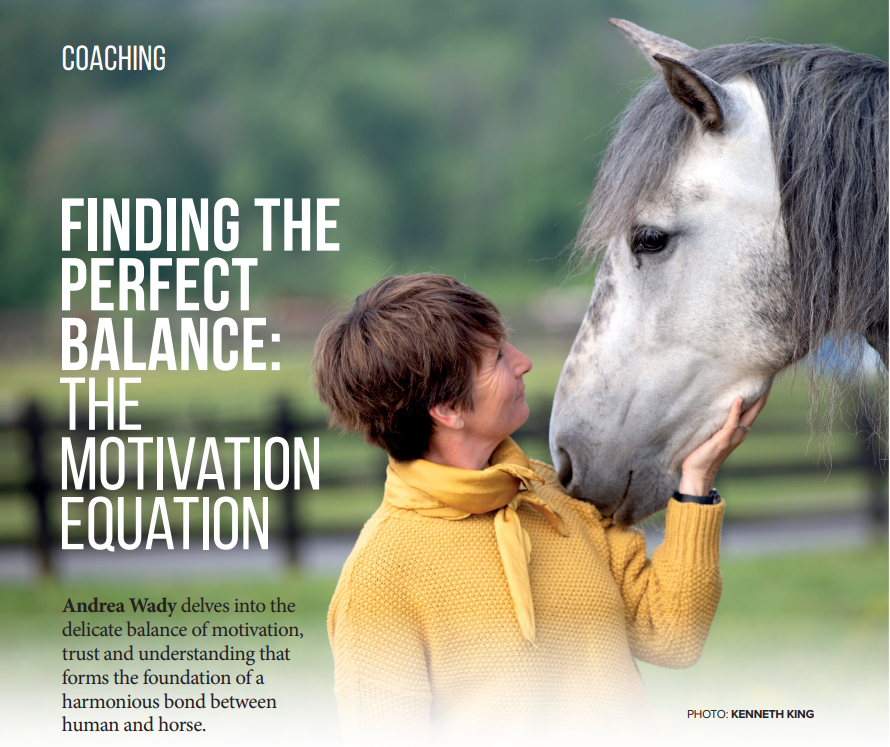
There is more than one way up a mountain with horses, and doggedly sticking to one method is not always in your horse's best interests. Doing what works for your horse in a given moment of its life can help create an unbreakable bond, but not in the pursuit of perfection. We might have ideas of how ‘we’ want to train, but if your horse is not understanding, not motivated to join you, or resisting your attempts on all levels (even if your goal is ‘let's just be friends’), then you have a problem with the motivation equation.
I was recently explaining this to a new student; her horse had had an accident in the stable and was terrified to go in. If we can't balance the motivation equation, the horse won't be going in the stable unless we use force… and of course, that's not happening. Another new student has a new horse who has been totally mis-sold to her, who has an extreme fear of being ridden due to past pain and is bolting. We can help these horses, but only if we manage the motivation equation well, but there is more to it.
I like to think of the equation as a seesaw. If you consider the seesaw balanced and still, then the two sides are equal. This is where I love my relationship to be; I don't need to bring up tons of motivation in whatever form that takes. I don't have to be in full-on leadership mode because we are in balance. Neither has to apply any momentum to bring the seesaw into a still and balanced place. Neither one is leading, and neither one motivating. However, this is a rare and fleeting moment in your relationship, a place you seek eternally.
Let's think of the opposite scenario: the left side is high in the air, and the right is sticking in the mud (we are on the left, and the horse is on the right). It is not a great place for either party to find themselves. Much motivation is needed to get the horse to want to push up out of the mud. Our choice of path is what will decide if the horse wants to seek balance or whether we will invoke a sense of resentment; a balance of the seesaw would then become impossible, and there would be a constant battle.
I saw this in effect recently when I took a young child on a fun ride. She had recently experienced a family tragedy and desperately wanted to go. We felt it would be good for her, but it wasn't something I would usually attend, as seeing horses being used like hairy bicycles is not my bag, but there was a bigger picture. Their seesaw was perfectly balanced; it was balanced all day! Seamlessly switching roles between who was leading and who was following, water to cross - no problem, the pony quietly stepped into the role and as the jumps approached, the young girl gently took up her reins and guided a willing Sky towards the lower fence that she felt safe to jump.
However, all around her, I could metaphorically hear seesaws plunging and slapping the ground, as riders grimacing in fear of the height they were at as their legs dangled helplessly on their seesaw, unable to touch the ground. Horses plunged and were massively overcorrected to slap them back into the seesaw mud again. I preferred to focus on the girl and her pony. So, let's look at this girl; she has had a handful of riding lessons and has studied no pure liberty, so what was her secret? Joy and a pure belief that they can do it, going with the flow if plans change. Interestingly, she even fell off without disturbing the seesaw. She went for a jump, and the pony wanted to make sure they were both safe, so with good intent, she massively overjumped it! The girl sailed over her pony's head, landed with a thump, and got her foot trod on as the pony tried very carefully not to crush her. I can hear you say, “how is that in balance?” It was, perfectly, because the relationship didn't falter. The pony had her nose on the girl's shoulder, willing her to get up. Whilst stroking her pony, she dried her tears and got back on. Balance is not always smooth sailing, but more about that later.
So, how can we motivate a horse? By doing something that feels dignified, calm, and something they can easily understand. This keeps the seesaw balanced and is relatively easy to do using harmony and quiet as a reward, maybe treats, maybe scratches, and for some, a well-timed release of gentle and understood pressure (we are not talking emotional fireballs with a training stick being waved and slapped around, note - no judgment, I have been that person at times in the past).
But what if the stakes are high? What can be done with a horse in a place of extreme fear, terrified of the situation it has to overcome to live in the human world? How do we motivate them? How do we solve the training dilemma of getting the job done? Relationship! First, foremost, and every time. Counter conditioning is tried and tested; it is incredibly effective with horses and works well when combined with food motivation. But if the fear is more motivating than the food, you will not achieve your goal, it is as simple as that. The relationship has to come first.
The trust has to be in such a place that they will cross that metaphoric raging river to be with you. Working in pure liberty with no restraint and no treats will build that rock you need for you and your horse to stand on together. I don't feel ‘we’, the human, are the rock anymore; I think we create a rock that we can stand on with our horse together. This can take a lot of time. Treats can come in to train specific behaviours, and make it fun and exciting, but this still needs to solve the equation when the stakes are high… I am getting to it. Does anyone need another cuppa?
Our goal is never to erase the trauma; that would be impossible and set you both up to fail. All you can do is create new neural pathways that the horse will feel are the place to take their mind when tackling something that previously worried them. Like I said, if the treat (or whatever reward path you choose) does not outweigh the fear, you will not reach your end goal. The fear will take over, and resistance will be felt, followed by a breakdown in the relationship. The older school way of making the wrong choice hard and the right choice easy will not, in my opinion, ever balance your seesaw (maybe in years to come, but not in the way I would want). The stress would become internalised and come back to bite you.
So, let's say we have walked the walk; the relationship is in a great place, but now we have to address the issue at hand, the extreme fear. How can we take the horse past the hard and fast 'no' into a place where they are willing to try to walk into the stable or allow someone to ride them. The answer lies in your relationship. If you are both in a place of mutual understanding, you will do this with your horse, not to your horse. My husband had a great mentor in hoof trimming, and he said, "What you are not doing for the horse, you are doing to the horse." I always try to remember this. So, where does it leave us now? Maybe you are standing outside the stall, with the horse terrified of confinement, with a cut so deep that the horse has to be kept clean for the sake of not getting an infection. My answer is to think outside the box.
Put yourself in your horse's mind. How would you feel if you had been violently attacked in an enclosed room? Would you ever feel safe there? Would any amount of chocolate make you want to walk in there? Hell no! If riding had created such a fear of pain, even though the pain has gone, a pain so sharp and stabbing that you thought you would die, would you want someone up there? HELL NO. So, what mindset do you need to balance the seesaw? You have to be prepared to fail.
Yep, that's what you get for reading this today… FAILURE. The willingness to fail and how fabulously liberating it is as a horse trainer. I refuse to be a trainer who polishes her medals of success at the sake of the relationship, who gathers more and more students who say… "Oh, she is amazing; she will get the job done." What that is saying is the trainer is willing to override the true feeling of the horse to get a result the student will be happy with. That result is always a 'yes' for the human. I refuse to be backed into that corner.
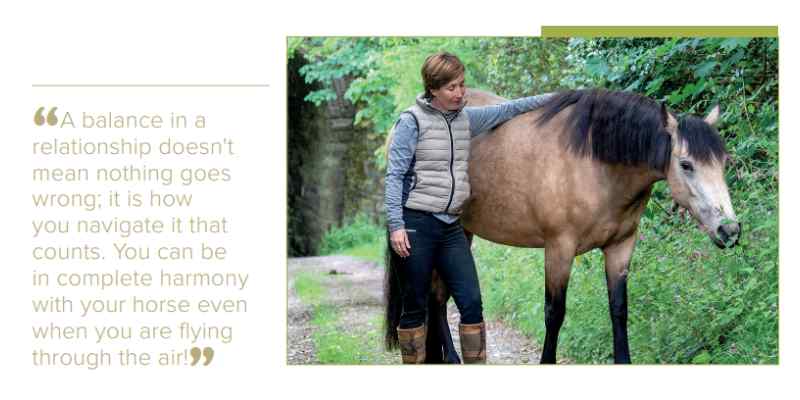
A balance in a relationship doesn't mean nothing goes wrong; it is how you navigate it that counts. You can be in complete harmony with your horse even when you are flying through the air! Seeing harmony as only looking like the unicorn connection sets you up for massive disappointment. Life can't be full of roses and joy at all times, but how you navigate the rocky road of life determines the results. Resistance is futile; life will always happen, and seeking harmony and connection during those times builds the depth of your relationship.
It was beautiful and inspiring to see the young girl get back on her pony and carry on with their friendship, not remotely dented. The fall was due to gravity and physics, not a communication or training breakdown. This is the fundamental mistake most horse people make. If something goes wrong, they bust out the training books and find a way to ‘correct’ the error. I say, ride the waves of life with your horse, and you can never get it wrong.
My best friends in this world have walked a path scattered with lives of inevitable wrecks, giant boulders with failures and heartbreak written all over them, my blood and tears smeared deep into the crevices. Deep holes of loss that were navigated with them at my side. Life is not all success and roses, but our relationship is intact; the scars bonded us deeper. It can be the same with your horse. Would my friends keep trying to help me overcome my fear of confined spaces, 100% yes, but they would be willing to join me solely in liberty if I could never overcome my fear of being ridden; they would help build a run-in shed, with a temporary corral, if I genuinely can't stand to have that stable door closed.
Are you willing to ‘epically fail’ in your training goals and walk the walk of life with your horse? The results might astound you in terms of the depths of relationships you can reach. 'No' has never felt so good!
Andrea Wady has spent her life with horses. Riding since childhood, she competed in show jumping, trained hundreds of horses, and even ran an award-winning horse tours company in the jungles of Costa Rica.
Taking a lifelong pilgrimage to see the world through the eyes of the horse, her adventures have included teaching clinics on Pure Liberty
around the world, and walking across Costa Rica with Zeus, a very damaged rescue horse.
Together, they discovered a whole new way of connecting and discovered what could exist beyond forgiveness. Her book Crossing Bridges won Best International Non-fiction at the celebrated Equus Film and Arts
festival in California.
Originally published in Horsemanship Journal Magazine.