I learned to ride before I learned anything about horses
She asks the question most of us never think to ask: if the only reward on offer is the removal of something annoying, where is the horse's reason to actually enjoy the work?

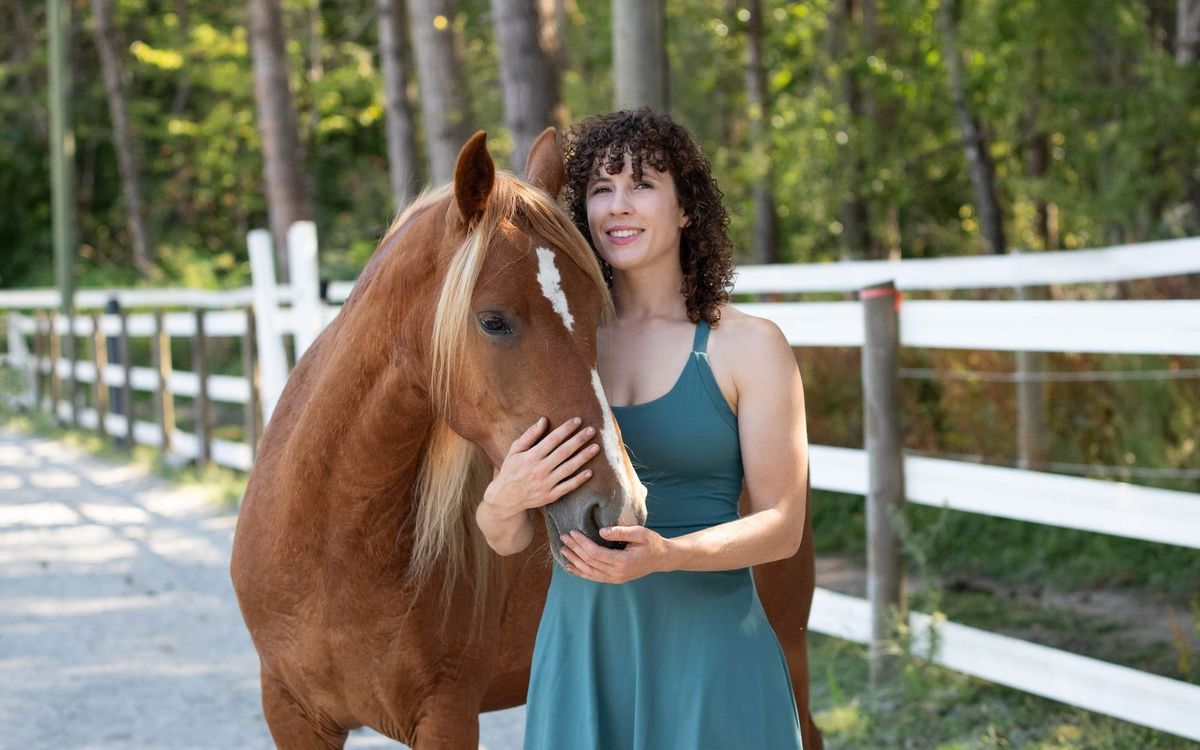
I learned to ride at a riding school, the way most of us did. I can still recite what I was taught: heels down, kick on, don't let him get away with it. If a pony napped or refused, that was defiance, and the answer was more leg and a growl. What I cannot recite is a single thing that education taught me about what a horse actually needs. Not turnout, not forage, not company; not one lesson on what all that obedience felt like from his side. We were taught how to get horses to do what we wanted, and we called that horsemanship.
Listening back to this week's episode, what struck me first was that all three of us had the same education, continents apart. Anna's riding schools ran on "never let it win". Shelby grew up showing on the Arabian circuit, taught from the age of four that a horse who did not listen had to be "got after", and reassured that it was fine: they're big animals, it doesn't hurt them. Nobody was being cruel on purpose. What changed her mind was not an argument. It was two things she could see with her own eyes. When her family hit financial trouble and her horse moved from a smart show barn to a yard where he lived out on 20 acres with a herd, the spooking and the bolting simply stopped. Nothing in his training had changed; only his life had. And then there was Milo, a rescue horse who, when she escalated pressure the way she had been taught, squared up and prepared to fight. The old playbook did not just fail; it was about to get her hurt.
Behaviour is a symptom
Behaviour is a symptom of a feeling. A horse cannot disrespect you, Shelby argues, because respect is a human idea; a horse is simply responding to what feels right in the moment, the way you or I would if we were dropped into a country whose language and etiquette we did not know. Once you take that seriously, the phrase "bad behaviour" starts to dissolve. The question stops being how do I stop this, and becomes what is he telling me.
There is evidence sitting under the philosophy, which is what makes it hard to wave away. Shelby is an IAABC-certified equine behaviour consultant, and she is precise about the mechanics. Traditional training leans on pressure and release, which is negative reinforcement, and for the release to work as a reward the pressure has to be at least mildly unpleasant to begin with. So the best the horse can hope for is relief. She asks the question most of us never think to ask: if the only reward on offer is the removal of something annoying, where is the horse's reason to actually enjoy the work?. On the sport she is just as exact, citing the study that found oral lesions in 87 to 88% of horses examined after one upper-level cross-country event, and she is careful with it in a way the internet rarely is: one event, she says, and it needs replicating. Her challenge to the industry follows from that care, not in spite of it: if these things are truly harmless, prove it.
What this means on a wet Tuesday
So what does this mean on a wet Tuesday, when you have twenty minutes and a horse who will not stand still to be tacked up? It means asking why before you correct. It might mean the honest answer is turnout, or forage, or company, rather than a firmer hand. And it means the permission Shelby is so good at granting: if your patience is already spent, you are allowed to not ride. Nothing about a horse's education is so urgent that it cannot wait for a version of you regulated enough to teach it.
None of this makes the horse easier to blame, which may be exactly why it takes work to accept. My horse wasn't misbehaving. He was the only one in the arena telling the truth.
After hours
The recording light went off, the cameras came down, and Anna reached for your questions. Listening back to the tape, it's a looser, franker conversation than the episode: the guilt of realising how much of what you were taught was simply wrong, and what it costs to change your mind in a world that treats changing your mind as weakness. The recording is below.
Have you had a Milo moment, a horse who refused the playbook until you changed it? What did you have to unlearn? Tell us in the comments; I read everything.
Curious Equestrian is independent and unsponsored. If it's been useful, you can support it here: curiousequestrian.co.uk/support
Find Shelby Dennis online
(The Bookshop.org links are affiliate links: they support independent bookshops and Curious Equestrian at no extra cost to you.)
Audiobook: Secrets of the Horse | Website: milestoneequestrian.ca | Instagram: @sdequus | Facebook: Milestone Equestrian | TikTok: @sdequus | YouTube: Shelby Dennis
```