She's Helped Horses in 26 Countries With Tape
The Woman Rewriting Equine Rehabilitation 30 Years, 26 Countries, & Rolls of Tape.

The horse that everyone gave up on probably wasn't difficult. It was sore.
I've been thinking about this since we recorded our conversation with Rebecca Haddock.
She started her career as a colt starter. Good at it, by all accounts. Then people began bringing her the problem horses, the ones with behavioural issues, the ones nobody could figure out. And what she noticed, almost immediately, was that the behaviour wasn't the problem. The pain was.
That's not a new idea. We've covered the pain-behaviour link on the podcast before. But what struck me this time was how far she took it. Because once she'd identified pain as the root cause, her next question was: how do I fix it cheaply enough that anyone can afford to do it?
The answer, for her, turned out to be a $13 roll of tape.
What the tape is actually doing
Kinesiology taping in humans goes back to the 1970s. It crossed into equine use around 2010 to 2012, and Rebecca is fairly blunt about the early version: it was a direct transplant from human practice, without accounting for the fact that horses are quadrupeds, prey animals, and don't have skin in the same sensory way we do.
The adaptation that matters is this. In humans, the tape works by interacting directly with the skin and its mechanoreceptors. Horses are covered in hair. So Rebecca rebuilt the modality from scratch to interact instead with the hair root plexus, the sensory network at the base of each hair follicle, and through that into the fascia and muscle beneath.
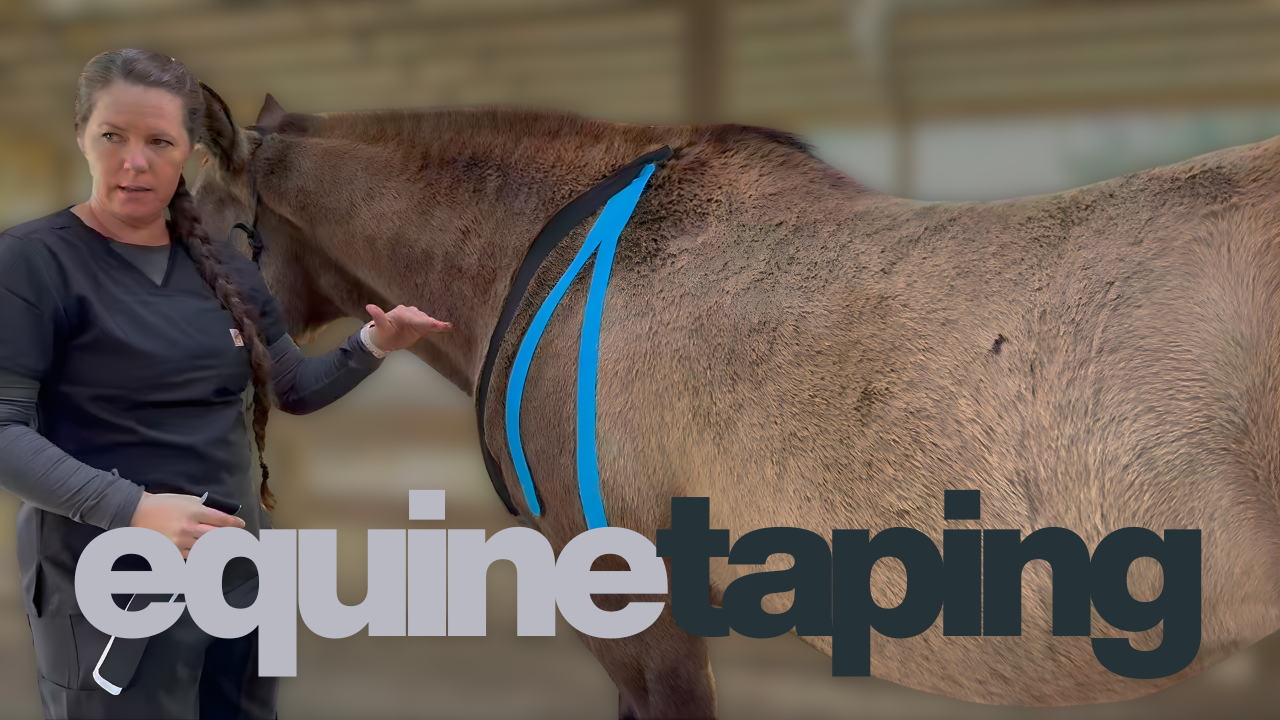
The mechanism she describes for muscle spasm is worth understanding. A hypertonic muscle, one that won't release, needs to be taped from insertion point to origin point at around 20% stretch. The recoil of the tape in movement sends a repeated signal to the golgi tendon organ at the insertion point, which responds by telling the muscle to relax and lengthen. She says you'll see a response within 30 minutes.
She's careful to distinguish between what's been clinically proven and what's currently supported only by case studies. That transparency, in a field where a lot of practitioners make sweeping claims, is worth noting.
What this means for your horse on an ordinary Tuesday
Rebecca's core argument is that horse owners have been told, by vets, by physiotherapists, by the industry generally, that this is too complicated for them. Her counter-argument is that there has never been a recorded injury from kinesiology taping in any species. You cannot hurt your horse with it.
That doesn't mean training is irrelevant. Placement matters, tension matters, knowing which muscle you're targeting matters. But she's built her education to be accessible to anyone who can operate a smartphone, and she teaches horse owners at the same level as practitioners.
The protocols for common issues, intermittent lameness, post-surgical recovery, fascia work, are available free on her website. The book, Stick with Success, covers both the taping and the broader picture: nutrition, lifestyle, pain recognition.
Whether you take it up or not, the underlying question she's asking is the right one. When your horse is behaving in a way that doesn't make sense, what are you assuming, and is that assumption worth examining?
The question we saved until the recording light went off
Rebecca spent most of this episode talking about the horses. In the after-hours conversation, we asked her something different: what happens when the industry pushes back, and why she keeps going anyway.
It's about ten minutes, and it's the part of the conversation that stuck with me most.
Free subscribers get the after-hours audio with every episode. If you're reading this in your inbox, you're already in. Hit play below.
If someone forwarded this to you and you'd like the after-hours conversation delivered to your inbox every fortnight, you can subscribe here, it's free.