The wrong question we ask about horse-human partnership
Communication in this tradition is less about training methods that produce compliance and more about building the kind of trust and mutual understanding where the horse can actually choose to participate.

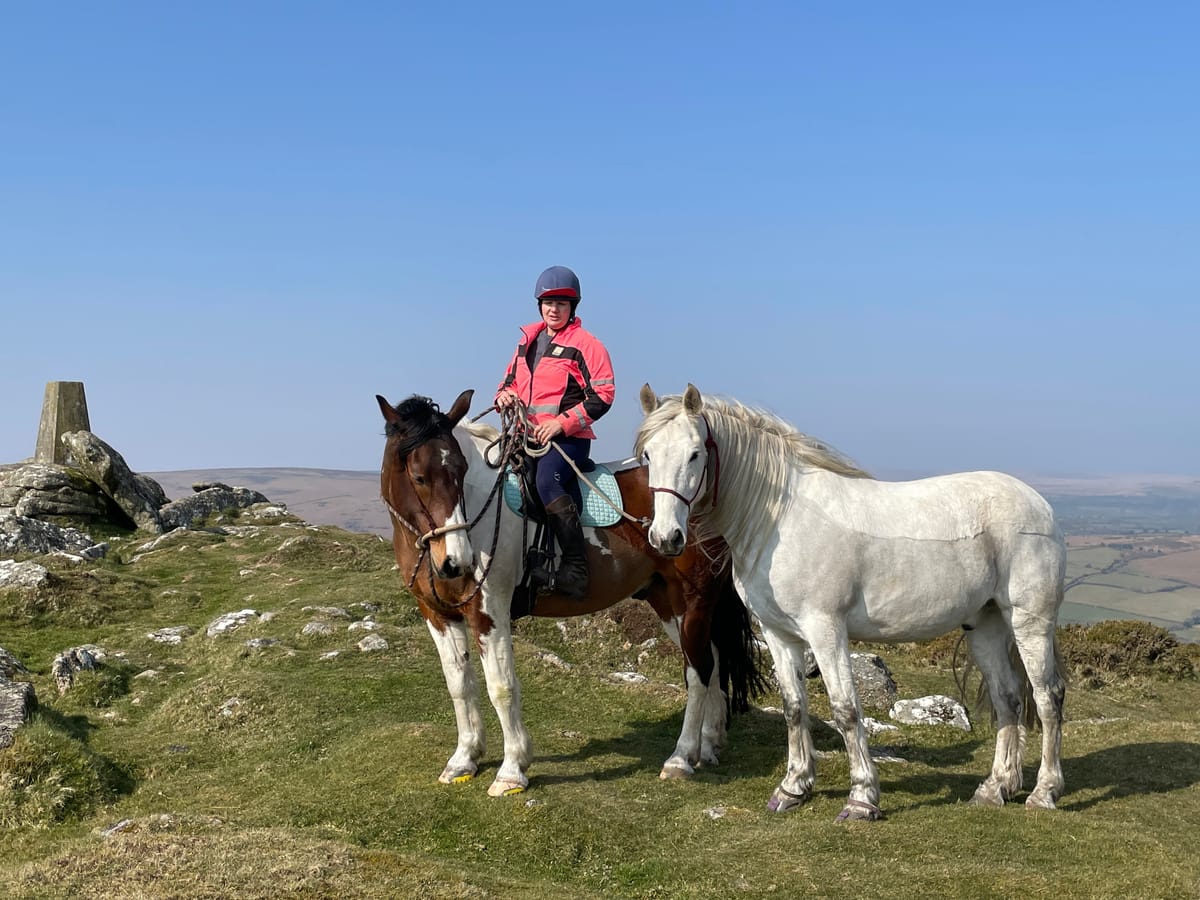
There is a specific kind of discomfort that comes from watching someone else's horse do something your horse won't. You find yourself thinking: maybe more schooling, maybe a different bit, maybe I'm the problem, maybe he's the problem. The thoughts go round. If that resonates then you'll appreciate this weeks conversation with Kate Sandel, who trains horses on Dartmoor and has spent the better part of her career thinking about the connection between a horse's emotional life and their physical body.
Something Kate said stopped the loop. She wasn't talking about training fixes. She was talking about the question we ask when we choose a horse, and whether we're asking the right one at all.
The question we get wrong before we even start
There's a moment most horse owners know. You're handling a horse who is technically fine: no lameness, no obvious vice, no dramatic incident. And yet something is off. The tension under your hands. The way he braces before you've done anything. You file it under 'needs more work' and carry on.
Kate Sandel would say the discomfort you're filing away is worth paying attention to. A horse trainer based on Dartmoor, with a background in French classical riding through Philippe Karl's school, equine sports massage, and human mental health, Kate spends a lot of time thinking about why a horse's emotional state and their physical state are not separate things. 'You cannot extract their brain from their body,' she says. The brace, the tension, the mild evasion: these are not training problems to be overwritten.
But here is where Kate's thinking takes a turn. She doesn't begin with what's wrong with the horse. She begins with what the human being brought to the horse-human relationship in the first place.
The wrong question
When most people buy a horse, the question running in the background is: is this horse right for me? We evaluate. We trial. We check for vices and vet for soundness. We think, reasonably enough, that we are the ones making the choice. The animal is the variable. The human is the constant.
Kate would flip this. 'About 70% of the time when things go amiss between a person and a horse,' she says, 'it's probably because the person misjudged who they were and what they could offer.' The horse did not fail the arrangement. The human misread themselves.
Self-knowledge in this context is not just personality. It is about what kind of real partnership you genuinely want, what you can provide in terms of time, handling, stimulation and emotional steadiness, and whether those things match what this horse needs to be well. 'They're not a push bike,' Kate says. 'They're also sentient beings with their own ideas and their own emotional lives.' That understanding has to come before the equine-human relationship can be anything useful to either of you.
What 'soft' actually means
The word at the centre of Kate's work is 'soft'. She's thought carefully about what it does and doesn't mean. 'Softness can mean so many different things to so many people,' she says. 'But I certainly don't think it means weakness.' In Kate's framing, softness describes a horse's internal state: a kind of okayness, the absence of bracing and guardedness, the presence of a horse who is, in her phrase, 'inspired by the movement rather than coerced into doing the movement.'
That distinction between inspiration and coercion is worth sitting with. Coercion can produce compliant horses; horses who go through the right movements without being particularly present in them. Inspiration requires genuine willingness, and genuine willingness is not something you can fake or force. 'Horses don't argue against their own happiness,' Kate says, paraphrasing her friend Jane Pike. 'If it feels better, happy days.'
This is where Kate's classical training background becomes relevant. Classical horsemanship asks exactly this: how do we bring a horse alongside mentally so that they are inspired rather than coerced? Communication in this tradition is less about training methods that produce compliance and more about building the kind of trust and mutual understanding where the horse can actually choose to participate. Riders who come from this tradition tend to talk about equine communication differently: less instruction, more conversation. Kate is clear that compassion without skill is not the answer. Good foundational training and genuine regard for the horse are not opposites. The horse given clear, consistent handling and also regarded as a creature with an inner life tends to do better than the horse managed with either quality alone. Harmony in the saddle, when it happens, is the product of that equine-human partnership built on the ground first.
Kate's benchmark is striking. 'I always think if I had a queue of people lining up for my horses when I died, I'd feel like I'd done as good a job as I could,' she says. 'None of them need to be doing flying changes or levade for that.' Not performance. Not achievement. A horse that people would want.
What you're actually offering
Buying or keeping a horse is not an act of consumption but an act of commitment. Whether you are looking for a rider's horse, a companion, or something in between, the question is not whether the horse suits you. The question is what kind of life you can genuinely offer, and whether that matches what this horse needs to thrive. Horse welfare, at its most practical, starts here, with an honest inventory of who you actually are.
'What they agree to is quite extraordinary,' Kate says of animals in a domesticated world not of their making. A horse who comes to participate rather than endure is offering something considerable. That's worth taking seriously before you start negotiating the price. The connection that follows, when it comes, is not a training outcome. It is the result of a human finally asking the right question, and an equine animal who has been given enough clarity and positive experiences to choose to show up for it.
Positive reinforcement, clear communication, and equine bodywork all get discussed in the full conversation, alongside what the French classical horsemanship tradition actually teaches about rider biomechanics and why so many horse owners are rethinking how they learn.
Inquisitive Herd - After Hours Tape
Most of us have had a lesson that left us feeling smaller, not bigger. Shouted at, corrected, confused, and somehow still expected to go back next week.
In the members' Q&A, Kate talks about what peace in a lesson actually means (and why it is not the same as feeling comfortable), how to prepare your horse to stay in a 'herd of two' when the arena around you gets busy, and what to look for before you ever book in with a new instructor. She also gets into the bodywork thread: how her equine massage training with Helen Tompkins, and a moment with Mark Rashid and a rein, changed what she thought was possible through touch, and why she now teaches owners to do it themselves. Find the member extras below.
'Riding and Release' by Kate Sandel. Available in our bookshop Practical and philosophical, for anyone rethinking their relationship with their horse.
Kate's website and membership: softandsound.org Online membership, courses, workshops and in-person clinics on Dartmoor. If the episode resonated, this is a good place to keep going.
'The Joy of Movement' by Dr Kelly McGonigal. Referenced in the episode in the context of walking with horses. McGonigal's research on endocannabinoids and sustained movement reframes why time moving quietly alongside a horse might matter more than we think.